

Buy Freshly Roasted Coffee Online: 2026 Guide
Table of Contents
- Why Roast Date Matters More Than Anything Else
- What Is the Peak Flavor Window for Coffee?
- How to Store Coffee Beans for Maximum Freshness
- Single-Origin vs Blend Coffee Beans: Which Should You Buy?
- Whole Bean vs Ground Coffee: What to Order Online
- Subscriptions, Shipping, and How to Avoid Stale Coffee
- Frequently Asked Questions
Last Updated: September 24, 2026
Why Roast Date Matters More Than Anything Else
The most important number on a bag of coffee isn't the price or the origin, it's the roast date. Freshly roasted coffee begins losing its best qualities within days, which is why buying freshly roasted coffee online from a roaster who ships to order beats a bag that's sat on a shelf for months.
Specialty Coffee Association's freshness research
What Is the Peak Flavor Window for Coffee?
The peak flavor window for coffee is roughly 7 to 21 days after the roast date, when beans have released enough carbon dioxide to brew evenly while still holding the volatile compounds that give coffee its aroma and complexity.
Degassing: Why Week One Tastes Different
Degassing is the process where roasted coffee beans release carbon dioxide trapped during roasting. This release happens fastest in the first few days and slows over the following weeks.
How to Store Coffee Beans for Maximum Freshness
Storage is about slowing two chemical processes: oxidation, where oxygen attacks the oils and acids that carry flavor, and degassing, where beans keep releasing carbon dioxide. Get it right and you stretch the peak window from a couple of weeks to closer to a month; get it wrong and a bag perfect on day ten tastes flat by day eighteen.
Here's what actually protects freshness, ranked by impact:
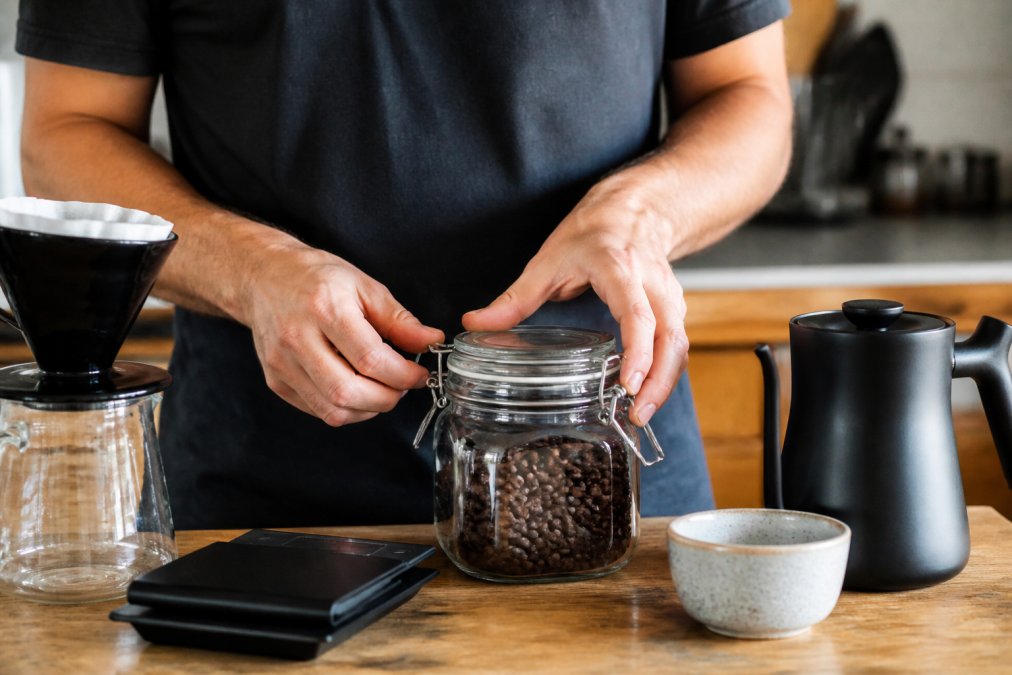
- Airtight, one-way valve container: Oxygen is the primary enemy. A sealed glass or ceramic jar with a rubber gasket works, but a bag or canister with a degassing valve is better because it manages CO2 pressure too.
- Opaque or dark storage: Light accelerates oxidation of coffee oils. Keep beans in a cabinet, not on a sunny counter or in a clear jar on an open shelf.
- Room temperature: Consistent cool conditions beat fluctuating cold ones. Every temperature swing pulls moisture in and out of the bean.
- Whole beans over ground: Grinding exposes roughly a hundred times more surface area to oxygen. A whole bean has hours of protection a ground particle doesn't.
- Buy smaller amounts more often: A 12-ounce bag you finish in two weeks beats a two-pound bag you open for a month. This is the highest-leverage change most buyers can make.
The Freezer Question, Answered Properly
The old advice was "never freeze coffee." The accurate answer: freezing works if done right and fails if done casually. The problem isn't cold, it's moisture. Every time you pull a bag out, condensation forms on the beans as they warm, and doing that daily actively degrades the coffee.
What to Skip
- Refrigerators: Worse than the freezer. Higher humidity, more temperature swings, and coffee absorbs odors from everything else in there.
- Hopper storage: If you have a grinder with a bean hopper, don't fill it for the week. Fill it for the day. The hopper is a wide, semi-open container that exposes beans to air constantly.
- Scooping with the container open: A common mistake is transferring beans into a nice container and then leaving it open while you brew. Every minute of exposure adds up. Seal it the moment you're done scooping.
How Storage Connects to Roast Date
Storage and roast date are two halves of the same problem: a bag roasted three days ago and stored poorly can taste worse than one roasted three weeks ago and stored well. That's why roast date transparency matters when you buy freshly roasted coffee online, without a date, you can't tell if you're buying into the front or back of the peak window.
Specialty Coffee Association's freshness research
Single-Origin vs Blend Coffee Beans: Which Should You Buy?
Single-origin coffee comes from one region, farm, or lot, while a blend combines beans from multiple sources. Neither is better on its own. Single-origin highlights a specific place and processing method, and blends are built for consistency and balance.
Roast Profiles and What They Mean for Your Cup
Roast profile describes how far a roaster takes the beans during roasting, and it shapes flavor more than almost any other factor.
| Roast Level | Flavor Notes | Acidity | Best Brew Method |
|---|---|---|---|
| Light roast | Floral, fruity, tea-like | High | Pour-over, drip |
| Medium roast | Caramel, nuts, balanced | Medium | Drip, AeroPress |
| Dark roast | Chocolate, smoke, bold | Low | Espresso, French press |
Whole Bean vs Ground Coffee: What to Order Online
Whole bean coffee stays fresh longer and lets you control grind size, making it the better choice if you own a grinder. Ground coffee is convenient but loses aroma within hours of grinding.
- Espresso: Fine grind
- Pour-over or drip: Medium grind
- French press or cold brew: Coarse grind
Subscriptions, Shipping, and How to Avoid Stale Coffee
A subscription solves the freshness problem only if it ships fast, roasts to order, and lets you control the schedule. Most complaints trace back to one of those three failing, and you can evaluate any roaster's setup in about two minutes before committing.
The Roast Date Transparency Test
This is the most useful check, and almost no buying guide explains it. A roast date is only useful if it's printed clearly and legibly. "Best by" dates are not roast dates, they're typically set months out and tell you nothing about when the beans were roasted. If a bag shows only a best-by date, assume the worst.
- A printed roast date, not just a best-by date. If you have to email customer service to find out when your coffee was roasted, that's a signal.
- A stated roast-to-ship window. The best operations roast and ship within 24 to 48 hours. Some rest beans for a few days before shipping, which is fine and often intentional, but they should say so.
- A shipping method that matches the promise. Two-day shipping on coffee roasted to order is meaningfully different from a week in a warehouse followed by two-day shipping.
How Shipping Time Interacts With the Peak Window
The peak flavor window, roughly 7 to 21 days after roast, is the clock your subscription races against. If a roaster roasts Monday, ships Tuesday, and coffee arrives Thursday, you're brewing on day three or four with the full window ahead. If it sits in a fulfillment center for a week, you start on day ten, having burned half the window before opening the bag.
Subscription Traps Worth Avoiding
- Fixed large shipments: You end up with more coffee than you can drink before it stales. A 2-pound monthly shipment is a lot of coffee for a single drinker.
- Slow or unpredictable shipping: If coffee sits in a warehouse for a week, you lose part of the flavor window before it even arrives.
- Hard-to-cancel plans: A subscription should be easy to pause when you travel or have a full shelf. If cancellation requires a phone call during business hours, that's a design choice.
- No roast date on the bag: Without a date, you can't tell how fresh the coffee really is, and you can't verify the roaster's claims.
- Grind-at-roaster with no freshness plan: Pre-ground coffee in a subscription stales faster than whole bean. If you don't own a grinder, order smaller bags and finish them quickly.
The fix is simple: choose a roaster who roasts after you order, ships promptly, prints the roast date, and lets you set a frequency matching how much you actually drink. Start with a smaller bag than you think you need, you can always increase it later.
Matching Frequency to Your Actual Drinking
A useful rule of thumb: one 12-ounce bag makes roughly 16 to 20 cups. Two cups a day means about a week and a half per bag, so a two-week cadence fits well; one cup a day suits a monthly cadence. The goal is to finish each bag while it's still in its window, not to build a pantry stockpile.
U.S. Department of Agriculture coffee market data
Frequently Asked Questions
How can you tell if coffee beans are freshly roasted?
Check the roast date printed on the bag, not just the best-by date. Freshly roasted coffee typically shows a visible roast date within the past 7 to 21 days. Whole beans look slightly glossy from surface oils after a few days, and they release a strong aroma when you open the bag. If the bag has no roast date or only says 'best by,' you cannot confirm freshness. Ordering from a roaster that roasts to order is the most reliable way to guarantee freshness.
Is buying coffee online fresher than buying from a grocery store?
Often, yes. Grocery store coffee may sit on shelves for months after roasting, and many bags only carry a best-by date rather than a roast date. Online roasters that roast to order ship within days of roasting, so the coffee reaches you inside the peak flavor window. The tradeoff is shipping time. Choose a roaster with fast fulfillment and check that they print the roast date on every bag so you can verify freshness yourself.
How long does freshly roasted coffee stay fresh?
Whole bean coffee tastes best within 7 to 21 days after the roast date. During the first 3 to 7 days, beans release carbon dioxide in a process called degassing, which can make espresso pull unevenly. After roughly 21 days, flavor fades faster, and by 6 to 8 weeks the coffee tastes flat. Store beans in an airtight container away from light, heat, and moisture to slow that decline.
What should I look for when buying specialty coffee online?
Look for a printed roast date, whole bean options, and details about origin and processing method. Single-origin listings should name the farm or region and describe flavor notes. Check the shipping policy to confirm beans ship within days of roasting, and read whether the roaster offers a subscription you can pause or cancel easily. If sustainability matters to you, look for direct trade or fair trade labels and clear sourcing information.
Most coffee problems trace back to one thing: the beans were old before you ever opened the bag. Hairy Coo Coffee fixes that by roasting to order and shipping direct, so your coffee arrives inside its peak flavor window. With single-origin beans, signature blends, and the option to support St. Jude Children's Research Hospital with every purchase, it's a simple upgrade to your daily routine. Get started with Hairy Coo Coffee and taste what fresh actually means.